Showing posts with label John Leeson. Show all posts

Tuesday, August 5, 2025

Leesons and beer.


A Little Bit Of Leeson Brewing History.

The Leesons were brewing beer in Dublin from about the 1680s onwards but details are hard to come by.
The first English Leeson brewer I have come across was Charles Leeson of 6 Horninglow Street, Burton on Trent. His brewery and maltings were founded during the 1720s by Willian Newton and acquired by Charles Leeson in 1753. The premises comprised of a house, garden, brewhouse, tun house, malthouses and other buildings. In 1801 the family executors sold the brewery to Joseph Clay and Son who owned the adjacent Lamb and Flag Brewery.


My Grandfather John Leeson (standing at the back) at work in the 1920s.

He was a drayman working for the Hammerton brewery (1921 census). Family oral history says that he drove his wagon and team of 4 horses through Blackwall Tunnel regularly. 


The brewery was located at 32 Frances Street, Woolwich according to the 1916 directory. This was just outside the gates of the Red Barracks and a stones throw from the family home in Back Lane. None of these buildings exist anymore.


Link to 1890s and 1940s Maps

The directory is from 1916, it was like the yellow pages of its time. At some stage the street were renumbered to how we know them, odds on one side, evens on the other.
The map is from approx. 1940s.
Here is an older map aprrox. 1890's which shows the corresponding buildings before they were demolished. Use the slider to mix between the two.


The current generation of brewers.

Wednesday, February 27, 2019

John Leeson's WW1 and WW2 Medals.

My Granddad's first and second world war medals.
The photos are of him in his RGA uniform during his recovery from his wound in 1917 and in his RAAF uniform at RAF Seal towards the end of the war.
John Leeson's Medals.
From left to right.
WW1 medals, British War medal and Victory medal.
WW2 medals, War medal and Defence medal.


Thursday, September 13, 2018

The RDC


The Royal Defence Corps.

John leeson had returned to England by May 1st 1917 and was at Plymouth hospital.  He was then moved to the following places during his convalescence and the rest of his service.

Camborne in Cornwall. 
Ripon (Yorkshire), on November 1st 1917. 
Tynemouth on 26th March 1918.
Ripon on 17th June 1918. 
Brocton (Canock Chase), on 29th June 1918 and finally,
Revesby outside Lincoln on 19th October 1918. 

On 4th February 1919 he was at No:2 Dispersal Unit, Crystal Palace.  He was given a £2 advance and 28 days furlough ‘after which uniform must not be worn’.  His pay and discharge documents were sent to 9, Albatross St, Plumstead.  He cashed his Postal drafts/Army money orders for his weekly pay whilst on furlough at Frances St Post Office, Woolwich, on 11th, 19th  and 28th February.
He was transferred to the Reserve on Demobilisation on 4th March 1919 (age 31).
His discharge certificate states he was by then a Private (78043) in 166th Protection Company, Royal Defence Corps and had also served in the Labour Corps as well as the R.G.A.  His medical classification on discharge was B2 and his place of rejoining in case of emergency was the R.D.C. Depot at 24 Sun St. E.C.2.

Much of his service during this time was with Northern Command as a PoW camp guard.

I recall Nanny telling a story of him having to guard prisoners and being ordered to shoot any who tried to escape.  He did not agree with that and said he would of deliberately missed.


Arthur Grant was wounded in France in 1915 and then became the commandant of the Brocton German prisoner of war camp from when it opened in 1916 to its closure in 1918/1919.

In 1917 Arthur Grant was stationed at Brocton, on Cannock Chase, as Commander of The Prisoner of War Camp. He also commanded the 166th and 167th companies of the Royal Defence Corps.
He lived at Brocton Leys with his family until 1919, when the camp on Cannock Chase was disbanded. Many of the prisoners of war died from an outbreak of influenza in 1918. 

RGC Cap Badge.


The R.D.C.

The Royal Defence Corps was a corps of the British Army formed in August 1917 and disbanded in 1936.
It was initially formed by converting the (Home Service) Garrison battalions of line infantry regiments. Garrison battalions were composed of soldiers either too old or medically unfit for active front-line service; the Home Service status indicated they were unable to be transferred overseas. Eighteen battalions were converted in this way.
The role of the regiment was to provide troops for security and guard duties inside the UK; guarding important locations such as ports or bridges. It also provided independent companies for guarding PoW camps. The regiment was never intended to be employed on overseas service.


From GWF.
PoW Camp Guards
Started by pdl, Dec 28 2011 10:32 AM

Paul: it's more likely that your list is of PoW camps, rather than of hospitals. Brocton and Ripon were both major PoW camps. Graham Mark in Prisoners of War in British Hands during WWI (Postal History Society 2007) mentions Revesby as a work camp but places a question mark in the column showing "parent camp".

I can't see a reference to Tynemouth, nor to Camborne, but these places may have had some other reason for needing a military guard. Camborne was a long way from a major PoW camp, the nearest being near Taunton (Sandhill Park, which accommodated officers who would not have formed working-parties) and Dorchester (Dorset).

And also


Northern Command
Nos. 151,153,154,155,156,157,160,161,162,163,164,165,166,168,169 and 170 Protection Companies [16]
Nos. 199 and 200 Reserve Companies [2]


Wednesday, May 31, 2017

Hospital Photos.

Photos of my Granddad when he was recovering from his wound.
John seated far left.

John second from right

John on the left, seated on bed,

Monday, May 1, 2017

My Granddad returns to England 1st May 1917.

A cross channel Hospital Ship - the St David.

On the cross channel Hospital Ship going home, there was a real fear of submarine attack.  They had a drill in the event of an attack.  During the drill the Doctor said to Jack, ‘Could you walk to that door?’ Jack replied, ‘I would crawl if I had to’.
He returned to England on May 1st 1917 [22 days after he had been wounded] and was sent to a hospital in Plymouth (4th Southern T.F. General Hospital - 193 beds for Officers and 1,029 for OR’s).  Before the war this was the Salisbury Road School, it then became a Territorial Force Hospital.

Plymouth Hospital.

1/5/17 is recorded on his medal roll saying that was the date he left the war zone.
He did not go to any other theatre of war after that, all his service was done at ‘Home’.
He was transferred to the RDC at some time after it was formed in August 1917.  So between May 1917 and August, he was recovering from his wound and must have spent some time in the Labour Corps [or just have been assigned to it], in this country.


Salisbury Road Junior School in 2012. Opened in 1903.

Wednesday, April 12, 2017

No:3 CCS and No:23 Ambulance Train

My Granddad was admitted to No: 3 Casualty Clearing Station on the day he was wounded [8/4/1917].
His wound was recorded as 'Wound type IX4'.  Gunshot wound of lower extremities, compound fracture of.
His notes say this made him eligible for a wound stripe to wear on his uniform.
There is also a note '500 units of anti-tetanus serum administered on 8/4/1917'.
He was then transferred on to No: 23 Ambulance Train on 11/4/1917.  This train would have taken him to one of the Base Hospitals at one of the channel ports.

No: 23 Ambulance Train.
3CCS was located at Aveluy just north of Albert [back down the road near where he joined the battery].  It had been there a month and was packing up ready to advance again with the army, to Grevillers just west of Bapaume.

Sunday, April 9, 2017

Easter Sunday (8th April) 1917


Here for the following two weeks they were occupied in wire-cutting and bombardments on the Hindenburg line with 106 fuses. There is no specific entry on the 8 April concerning 140 SB just a general wire-cutting and bombardment continued. 
Tactical: Bombardment of the Hindenburg line 3-11 April. Casualties: (for the month) 8 Killed. 2 Officers and 26 OR’s wounded.

He was seriously wounded on Easter Sunday (8th April) 1917.  The battery he was with moved forward for a surprise attack at dawn.  They were having breakfast in the kitchen of an old farmhouse when a German spotter plane came over and saw them.  The Germans then shelled them first.  The farm suffered a direct hit and he was standing by a window and was blown out of it.  He was the only survivor of his party.  He had a piece of shrapnel go through the top of his right thigh and into his left. 
  He was seriously wounded and could not walk.  The piece of shrapnel was later removed and he kept it on his bedside table in hospital until someone pinched it. 

No:3 CCS records state. 12 casualties that day.  3 KIA, 5 DOW and 4 survived. 

The three killed were.   Corporal Edward Brittan (8028), from Wolverhampton, age 30,  Thomas Carter (70697), from London, age 30  and Walter Haylett (79091), also from London.   They are all buried together at the Achiet-le-Grand cemetery, 19km south of Arras [grave refs I C 6, 7 & 8].   

One report states.  Guns in action, 9 (for the whole group). 2 Gunners of 194 SB injured by shellfire’. [2 killed Martin & Kay].

Thursday, April 6, 2017

Howitzer Film

A short bit of film from Youtube of the type of howitzer used by 140 SB.

Note the number of gun crew involved [10 men].

Also note the roof tiles falling off the barn, due to the concussion, when the howitzer fires near the end of the film.

https://www.youtube.com/watch?v=DY5Zx10gunM


14 HAG actions April 1917.

April 4th.  34 SB, also at Morchies, had 7 men killed and 9 wounded.
April 6th.  1194 SB had 2 howitzers destroyed.
April 7th.  The whole of 14 HAG fired about 1,000 rounds on the Hindenburg Line. Wire cutting, grazing type shells, in preparation for the 5th Australian Divisions attack.

Locations of the 4 Siege Batteries in 14 HAG.

Monday, April 3, 2017

Fourth Battery Move.

140 Siege Battery RGA.  3rd April 1917.

14 HAG is now 34 SB, 88 SB, 140 SB and 194 SB.
The battery moved forward about 3 miles, to the small village of Morchies.
Another over night move in heavy snow.
All in action and targets registered by dawn.


Morchies today.


Sunday, March 26, 2017

Third Battery Move.

140 Siege Battery RGA.  26th March 1917.

The battery now moves to Beugnatre.  North west of Bapaume.  A move made during two nights of about 5 miles.


They were now back in range of the Germans and start firing again in support of the Australian attack on Lagnicourt.  They had not fired for over a week.

The ruins of the Lagnicourt Church, showing the extensive shell damage the building sustained. Australian troops fought many desperate engagements with German forces around this area. (AWM E04580).

Tuesday, March 21, 2017

Joining the ANZACs

140 Siege Battery RGA.  21st March 1917.

My Grandad's battery is transfered from 36 HAG to 14 HAG under the command of 1st ANZAC Corps due to army reorganisations as the war moves on and more units are moved north to the Ypres front.
14 HAG comprised of 33 SB, 34 SB, 42 SB, 88 SB, 140 SB and 194 SB.


ANZAC artillery 'Zig Zag' flash.
Worn as a distinguishing unit indication at the head of each sleeve for 36 Australian Heavy Artillery Group from 1917 to 1918 and 36 Australian Heavy Artillery Brigade from 1918 to 1919. 

Wednesday, March 15, 2017

Second Battery Move.

140 Siege Battery RGA.  15th March 1917.

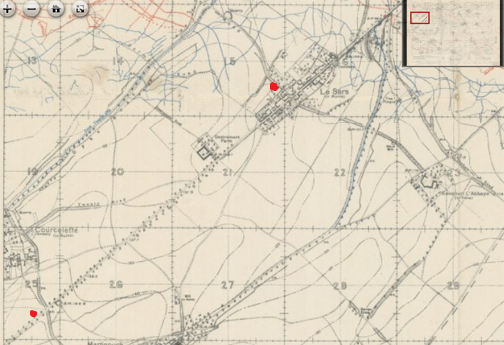
With the Germans continuing to fall back the battery was almost out of range.  It was time to move forward again.  Two howitzers joined 115 SB at Le Sars and the other two were on the road to Le Sars.  This was an advance of just over 3 miles.  See Somme map of 30/10/16 for the position of Le Sars.  Corps Commander visits and praises them for their good shooting.  Heavy snow.  Lots of men needed to work on the light railway, extending it to the new positions.
The two positions marked in red.

Friday, February 24, 2017

First Battery Move.

140 Siege Battery RGA.  25th February 1917.

November 1916:
Mainly supporting 19th Division, firing about 200 rounds per day. Very muddy and under fire from gas shells.
December:
The light railway supplying their ammunition was badly shelled.  Ammo limited to 30 rounds per day.
January 1917:
Supporting the 11th Div firing 30 rounds per hour all day [8th Jan] and nearly 500 on Jan 11th.  Very cold -10C.  A German plane [Albatross] was brought down and they captured the pilot and navigator.  More snow.
February:
No:4 Squadron RFC spotting for them.

As the Germans fell back at the end of the Battle of the Somme, the heavy guns advanced to keep in range.  140 SB moved from the Authuille Wood position on 25th February 1917 to a new position, Mouquet Farm, not far from Thiepval.
The battery was still part of 36 [Australian] HAG [Heavy Artillery Group] and contained the following siege batteries: 54 SB [Australian], 56 SB, 115 SB and 140 SB.


Red flag marks the new battery position.  Map ref R33a07.

The battery move from grid 12 to grid 33, about a mile.

Wednesday, December 21, 2016

140th Siege Battery RGA.


A little back ground to the battery my Grandfather joined.

Battery History.

140th Siege Battery, R.G.A. was formed on 22/5/1916.

140 SB was formed at Sheerness, one of ten new siege batteries formed in May 1916. This was a modern, mechanised battery [not horse drawn] and went out to the western front in August 1916, one of 25 new Siege Batteries sent out that month.  Its armament was 4 x 6” Howitzers of the new 26 cwt type.

140 SB was sent to the Somme to join 15 Heavy Artillery Group [HAG] 7-8-16, was moved to 36 [Australian] HAG 10-9-16 under the command of 2nd Corps and joined 14 HAG 21-3-17 under the command of 1st ANZAC Corps.
The battery commander was Maj A.G.C.Smythe who was also the OC of 36 HAG at one point.


Battery Equipment.

4 x 6” Howitzers of the new 26 cwt type.

Rapidly developed at the beginning of the war, its combination of firepower, range and mobility (for its day) made it one of the British Empire's most important weapons in the war.
Over 3,600 were made and they were still in use at the end of WW2.
Crewed by 10 men, it could fire two, 100 lb shells, per minute, up to 5½ miles.  They fired over 22 million shells on the Western Front alone.
The 106E percussion fuse was introduced in 1917 - its sensitive 'graze' action allowed it to explode on the surface and clear wire entanglements effectively.

Transport for a mechanised 6” How battery consisted of:-

4 x quadruple driven lorries [gun tractors]
13 x 3-ton lorries
1 x motor car
7 x motorcycles

This was broken down as follows:-
For the Guns and their equipment….4 quadruple driven lorries….8 drivers
For ammunition….8 x 3-ton lorries…..16 drivers
For baggage and stores….3 x 3-ton lorries….6 drivers
For personnel….1 x car….1 x driver
For personnel….7 x motorcycles
For supplies….1 x 3-ton lorry….2 drivers
Spare…. 1 x 3-ton lorry….2 drivers
Each battery was also supplied with one water tank.


Battery Personnel.

Major 1
Captain 1
Subalterns 4
BSM 1
BQMS 1
Sergeants 5
Smiths 2
Wheeler 1
Trumpeter 2
Corporals 6
Bombardiers 6
Gunners 100.  This includes 8 acting Bombardiers and 21 Signallers and Telephonists
Batman 6 [for the 6 Officers].

Total 136

Attached personnel

Army Ordnance Corps [A.O.C.] Armament Artificer 1

A.S.C. Motor Transport [M.T.]
Subalterns 2
Sergeants 3
Batmen 2
Drivers - lorries 34
Motor car 1
Spare 15% 6

Total attached 49

Battery Grand Total [including attached] - 185


Gun Detachments.

The 4 guns each had 30 men split into 3 shift rotas (10 men per gun per shift) of 24 hour working plus signallers.
A sub section comprised of about ten men and the functions of each man in the sub section was identified by a number from 1 to 10. The list below explains the basic functions for each member of the gun detachment. 
No.1 The gun commander responsible for supervising the actions of all other members of the detachment and gives the order to fire.
No.2 Opens and closes the breech, puts the gun in and out of firing position, operates the right brake once gun is laid and fires the gun.
No.3 With number 5 rams home the round. Uncaps fuses. Operates the left brake once the gun is laid.
No.4 Acts as gun layer with number 1.
No.5 With number 3 rams home the round and assists number 10 with cleaning and preparing fuses.
No.6 Prepares, fetches and loads shells
No.7 Carries shells to the gun. Assists number 10.
No.8 An NCO, prepares charges and keeps records of charges.
No.9 Carries shells to the gun. Assists number 10.
No.10 Issues shells and ensures shells are clean and fused.  

No.1 was a Sergeant, and commanded the sub-section.
A Subaltern commanded a section of two guns.

 6” Howitzers

 A quadruple driven lorry [gun tractor]

3-ton lorries


Sunday, October 30, 2016

My Granddad goes to the front.

30th October 1916.

My Granddad leaves Le Havre to join his unit at the front.


He goes to join 140 Siege Battery RGA on the Somme.
A battery of 4, 6" Howitzers.


The battery position was at Authuille Wood, near Aveluy, just north of Albert.
The Battle of the Somme was in its fourth month.
Reginald Groves had been killed near Le Sars on the first of the month.


This shows the exact location of the battery on a WW1 trench map.


The battery was part of 36 [Australian] HAG [Heavy Artillery Group] and contained the following siege batteries: 14 SB, 23 SB, 33 SB, 80 SB, 129 SB, 140 SB and 177 SB.

Friday, October 21, 2016

My Granddad goes to war. 1916.


Gunner John Leeson RGA [96749].

He volunteered on the 10th December 1915, [age 27].  Conscription was introduced by law on 27/1/16.  But such was the flood of volunteers that he was not called up immediately.
He was not mobilised until 12-16th June 1916 at Fort Burgoyne, Dover, which was No.1 Depot Royal Garrison Artillery [RGA].  This depot processed about 1000 recruits per month.  He underwent four months training [16/6/16 to 21/10/16] drill, gunnery and fitness.

He had vaccinations on 28th July 1916 and 29th August at Fort Grain in Thames estuary.
This was the base for 18 Company RGA under Major R. Keogh.

There is also a note in his pay book, ‘3 [B] Siege Depot Bexhill’, which is near Hastings, so he may also have been posted there during his training.

Prior to going to France he was at No:2 Depot, RGA, at Fort Brockhurst, Gosport.


 On 21st October 1916 he was moved overseas to B. S/Bty (Base Depot, Siege Batteries) RGA at Le Havre, France and was placed on active service in the B.E.F. (British Expeditionary Force), the next day he was issued with his pay book and he wrote and signed his will which was a section of that book.
Le Havre was a massive base for supplies, reinforcements and remounts (horses).
The RGA’s No:1 General Base Depot was located at Camp 12, approximately a quarter of a mile to the west of Harfleur station.


There he was processed for the front and only now allocated to his unit.  He was there for 8 days till 29/10/16.  He was posted to 140 Siege Battery RGA on 30/10/16.
140 SB was then part of 36 [Australian] Heavy Artillery Group (HAG), in the II Corps, of the 5th Army, positioned at that time on the Somme, supporting the final phases of the battle that had started on 1st July.