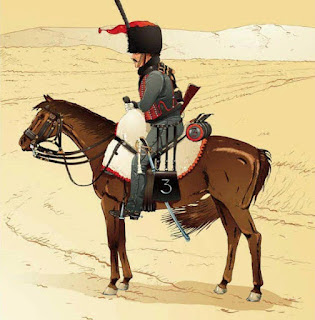
The Hinckley Volunteer Infantry - 1803.
In 1803 there was a real fear that Napoleon would cross the channel and invade England. This was a very real threat as the French had landed in Ireland in 1796, Wales (Fishguard) in 1797 and Ireland again in 1798-99. The regular army had been built up, the militia called out and local Fencible Regiments raised. Leicestershire’s Fencible Regiment was raised in November 1794 and disbanded prematurely in 1801-2 as a result of the Peace Treaty of Amiens signed with France in March 1802.
In 1803, the inhabitants of Hinckley subscribed £678 15s. 6d. for the support of the Hinckley Volunteer Infantry, a new volunteer unit raised on 7th September probably to replace the Fencibles. There were 19 such units raised at that time in the county.
The Hinckley Volunteers were commanded by 27 year old Dudley Baxter Esq (from Stoke Golding, 1776 - 1837) as Major-Commandant. He was later Lt Colonel-Commandant of the 2nd Battalion or West Leicestershire Regiment of Local Militia and Deputy Lieutenant of the County of Leicestershire.
There were four Captains, John Green, Charles Jervis, John Hill and John Derrington, Esqs.
Four Lieutenants, Francis Critchley, James Cooper, Nathaniel Estlin and George Perry, Gents.
And four Ensigns, John Browne, Thomas Needham, John Gutteridge and William Nurse, Gents.
So the Volunteers were a unit made up of four Companies. In theory the unit could have been up to 400 strong, (the population of Hinckley was 5200 in 1801).

The figure shows the uniform of the volunteers. The facing colours (collar and cuffs) are white as per the Leicestershire Regiment.
Such was the fear of Napoleon’s threatened invasion of Britain that in 1804 480,000 men (nearly 1 in 5 of the able bodied men) were in uniform. It was not until Nelson’s victory at the Battle of Trafalgar that the threat was removed once and for all and only after Waterloo could the country return to normal and all the Militias and Volunteers stood down.
