Sunday, April 9, 2017

Easter Sunday (8th April) 1917


Here for the following two weeks they were occupied in wire-cutting and bombardments on the Hindenburg line with 106 fuses. There is no specific entry on the 8 April concerning 140 SB just a general wire-cutting and bombardment continued. 
Tactical: Bombardment of the Hindenburg line 3-11 April. Casualties: (for the month) 8 Killed. 2 Officers and 26 OR’s wounded.

He was seriously wounded on Easter Sunday (8th April) 1917.  The battery he was with moved forward for a surprise attack at dawn.  They were having breakfast in the kitchen of an old farmhouse when a German spotter plane came over and saw them.  The Germans then shelled them first.  The farm suffered a direct hit and he was standing by a window and was blown out of it.  He was the only survivor of his party.  He had a piece of shrapnel go through the top of his right thigh and into his left. 
  He was seriously wounded and could not walk.  The piece of shrapnel was later removed and he kept it on his bedside table in hospital until someone pinched it. 

No:3 CCS records state. 12 casualties that day.  3 KIA, 5 DOW and 4 survived. 

The three killed were.   Corporal Edward Brittan (8028), from Wolverhampton, age 30,  Thomas Carter (70697), from London, age 30  and Walter Haylett (79091), also from London.   They are all buried together at the Achiet-le-Grand cemetery, 19km south of Arras [grave refs I C 6, 7 & 8].   

One report states.  Guns in action, 9 (for the whole group). 2 Gunners of 194 SB injured by shellfire’. [2 killed Martin & Kay].

Thursday, April 6, 2017

Howitzer Film

A short bit of film from Youtube of the type of howitzer used by 140 SB.

Note the number of gun crew involved [10 men].

Also note the roof tiles falling off the barn, due to the concussion, when the howitzer fires near the end of the film.

https://www.youtube.com/watch?v=DY5Zx10gunM


14 HAG actions April 1917.

April 4th.  34 SB, also at Morchies, had 7 men killed and 9 wounded.
April 6th.  1194 SB had 2 howitzers destroyed.
April 7th.  The whole of 14 HAG fired about 1,000 rounds on the Hindenburg Line. Wire cutting, grazing type shells, in preparation for the 5th Australian Divisions attack.

Locations of the 4 Siege Batteries in 14 HAG.

Monday, April 3, 2017

Fourth Battery Move.

140 Siege Battery RGA.  3rd April 1917.

14 HAG is now 34 SB, 88 SB, 140 SB and 194 SB.
The battery moved forward about 3 miles, to the small village of Morchies.
Another over night move in heavy snow.
All in action and targets registered by dawn.


Morchies today.


Sunday, March 26, 2017

Third Battery Move.

140 Siege Battery RGA.  26th March 1917.

The battery now moves to Beugnatre.  North west of Bapaume.  A move made during two nights of about 5 miles.


They were now back in range of the Germans and start firing again in support of the Australian attack on Lagnicourt.  They had not fired for over a week.

The ruins of the Lagnicourt Church, showing the extensive shell damage the building sustained. Australian troops fought many desperate engagements with German forces around this area. (AWM E04580).

Tuesday, March 21, 2017

Joining the ANZACs

140 Siege Battery RGA.  21st March 1917.

My Grandad's battery is transfered from 36 HAG to 14 HAG under the command of 1st ANZAC Corps due to army reorganisations as the war moves on and more units are moved north to the Ypres front.
14 HAG comprised of 33 SB, 34 SB, 42 SB, 88 SB, 140 SB and 194 SB.


ANZAC artillery 'Zig Zag' flash.
Worn as a distinguishing unit indication at the head of each sleeve for 36 Australian Heavy Artillery Group from 1917 to 1918 and 36 Australian Heavy Artillery Brigade from 1918 to 1919. 

Wednesday, March 15, 2017

Second Battery Move.

140 Siege Battery RGA.  15th March 1917.

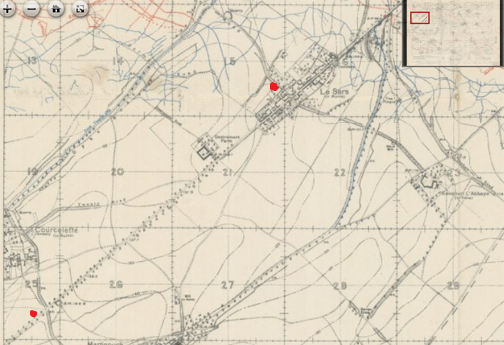
With the Germans continuing to fall back the battery was almost out of range.  It was time to move forward again.  Two howitzers joined 115 SB at Le Sars and the other two were on the road to Le Sars.  This was an advance of just over 3 miles.  See Somme map of 30/10/16 for the position of Le Sars.  Corps Commander visits and praises them for their good shooting.  Heavy snow.  Lots of men needed to work on the light railway, extending it to the new positions.
The two positions marked in red.